
Polyaspartic · the cold-season floor
Polyaspartic floor coating in Coeur d'Alene, Idaho
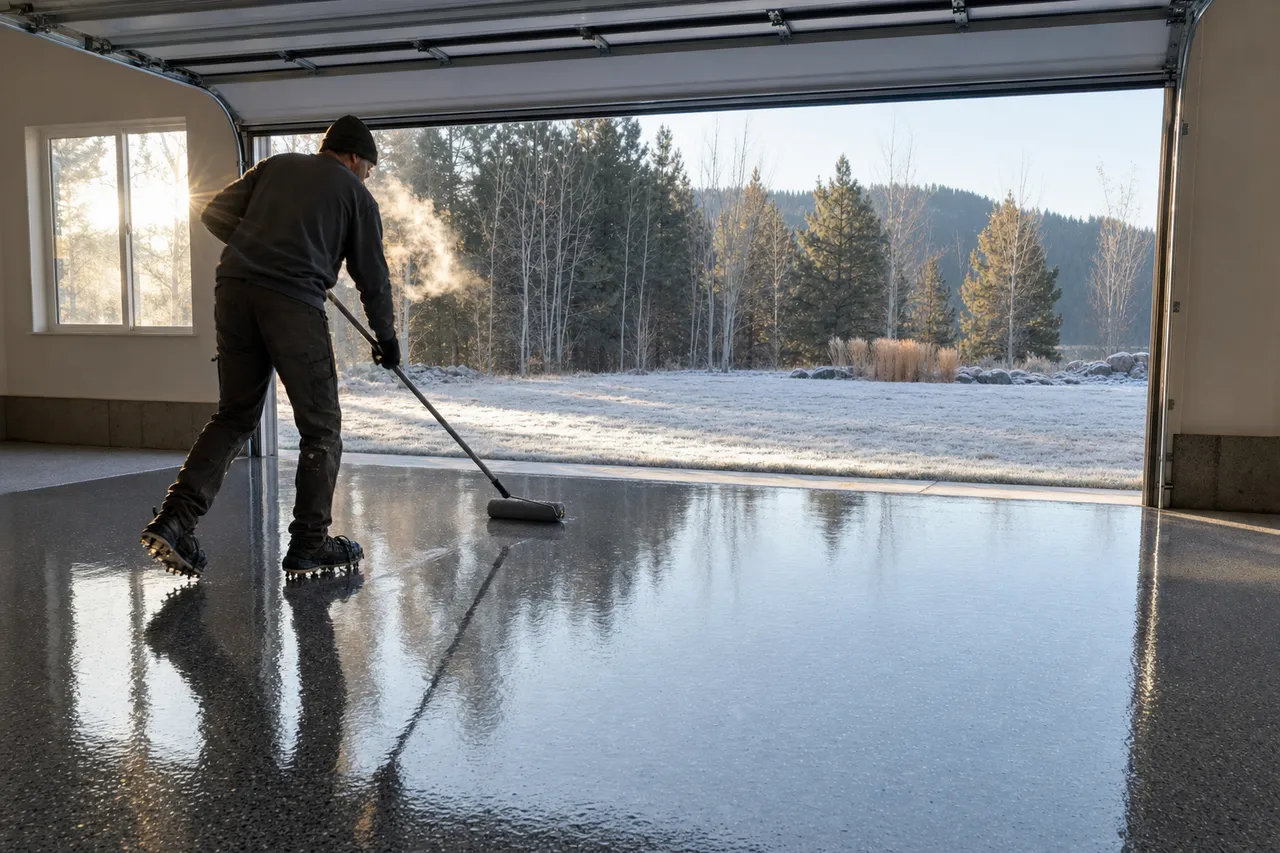
The top coat the pros use and a kit cannot ship. It cures in hours instead of days, keeps curing when the slab is below freezing, never yellows along the door line, and takes carbide studs like pavement. As a full system it puts a finished floor under you in one working day, in any month North Idaho has.
The slab gauge
Which system can cure on your concrete this month
Air temperature is not the number. Slab temperature is. A two-part epoxy stops curing properly once the concrete drops under fifty degrees, and an unheated Coeur d'Alene garage slab lives in the thirties and low forties from November into March. Polyaspartic cures on that same slab in a few hours. That one fact decides more floors here than any color chart.
- April to October: epoxy base plus polyaspartic top, or polyaspartic straight through, your pick
- November to March: polyaspartic, or wait for warmer concrete
- A heated shop on Hayden's industrial side moves the gauge with the thermostat, not the calendar
Unheated garage slab, Nov-Mar (28-46°F)Apr-Oct (52-78°F)
Below 50°F the cure stalls; the floor stays soft and lifts under the first hot tire.
Cures in hours, down into the twenties with the right product. The winter floor in Kootenai County.
A close relative of polyaspartic, same cold-cure range; usually the base under a polyaspartic top.
Slab temperature, not air temperature. A meter on the concrete decides the date.
The referee
Epoxy, polyaspartic, polyurea: what each one actually does
Three chemistries, one garage. They are not competitors so much as layers with different jobs, and the "twenty times stronger" line that gets repeated around Kootenai County is a comparison between the thinnest of one and the thickest of another.
100% solids epoxy
Builds thickness and bonds hard to ground concrete. It is the base layer on most professional garage floors for a reason. The honest weaknesses: it ambers where sun hits it along the door line, it cures slowly, and it will not cure on a cold slab. Epoxy is never the wear surface; something has to go on top.
Polyaspartic
An aliphatic polyurea formulated to cure at a workable pace. UV-stable, so it never yellows. Abrasion-hard, so studs and grit wear it slowly. Slightly flexible, so it rides out a freeze-thaw winter without cracking. Cures in hours, well below freezing. Costs more per square foot and punishes an unpracticed crew, because the pot life is short.
Polyurea
The parent chemistry. Fast-setting, flexible, cold-tolerant. On a garage floor it shows up as the base coat under a polyaspartic clear in a "polyurea system," and the strength claims attached to it compare a full polyurea build to a hardware-store epoxy kit. Against a real epoxy base the gap nearly closes; the difference is cure speed and cold, not toughness.
The verdict for most Coeur d'Alene garages: an epoxy base for build and bond, a polyaspartic clear on top for the wear, the UV, and the winter. When the slab is cold or the schedule is one day, polyaspartic straight through. What you should never accept is epoxy with nothing over it, or a January date on an epoxy quote.
One working day
Grind in the morning, park the next day
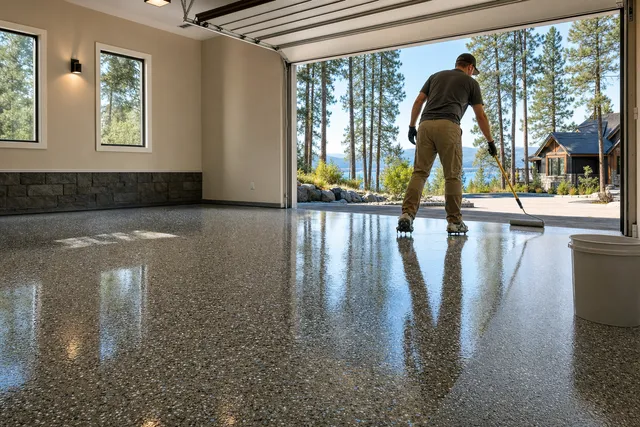
The one-day system exists because polyaspartic cures in hours. The slab is diamond-ground with dust extraction and metered first thing, cracks cut and filled, spalls by the door patched, then a pigmented polyaspartic base goes down, the flake is broadcast to full coverage, scraped, and the clear coat is rolled before the crew leaves. Walk on it that evening. Park the next day. In a town where the slab is cold half the year, that is the schedule most garages get.
- Full flake, solid color, or a metallic base under the clear
- The same prep as a two-day epoxy flake floor, compressed into one crew day
- Priced side by side with the epoxy-base system on every written estimate
Cold slab or a tight week? Say so, and the estimate names the system.
Call with the square footage and the month you want it done, and hear whether it is an epoxy floor or a polyaspartic floor before anyone comes out.
Where it earns the price
Four places a polyaspartic top coat pays for itself here
- The door line. Every south-facing garage on the Rathdrum Prairie gets a stripe of sun across the apron. Bare epoxy ambers there in a year; polyaspartic is aliphatic and does not.
- The tire tracks. Carbide studs from October through April, hot tires off the lake road in July. The top coat is the layer that takes both.
- The slab that never warms. A detached garage, a shop with the door open all day, a Hayden Lake cabin coated in the shoulder season. Polyaspartic cures where epoxy cannot.
- The weekend. One crew day instead of two, and the cars back in the next morning.
Ask which top coat a quote is based on. If the answer is "epoxy" with nothing over it, the quote is for a two-year floor.
By the square foot, installed
- Polyaspartic one-day system$9 - $13
- Epoxy base + polyaspartic top, full flake$7 - $10
- Solid-color epoxy with a clear top$5 - $7.50
- Moisture mitigation, when the meter calls for it$1.50 - $3 per sq ft
Prep and top coat included. Whole-garage ranges and the cold-season lines are on the pricing page.
Asked around Kootenai County
Polyaspartic questions, answered without the marketing
Is polyaspartic really stronger than epoxy?
As a top coat, yes: it is harder, it does not yellow in sunlight, and it stays slightly flexible through a freeze-thaw winter, which is why it is the wear layer on a full-thickness garage floor. The "4x stronger" and "20x stronger" lines you see around Kootenai County compare a thin hardware-store epoxy kit to a full polyurea system, which is not a fair fight. A 100% solids epoxy base bonded into ground concrete, with a polyaspartic clear coat on top, is the strongest garage floor either chemistry can build.
What does a polyaspartic floor cost in Coeur d'Alene?
A full polyaspartic one-day system runs $9 - $13 per square foot installed over diamond-ground, metered concrete, against $7 - $10 for a two-day epoxy-base flake floor. On a two-car garage that is a few hundred dollars more for a floor that is parked on the next day and can be installed in January. The written estimate prices both systems side by side so the choice is yours.
Can polyaspartic really be installed in winter here?
Yes, and it is the reason the cold months are not dead months for coatings in North Idaho. Polyaspartic keeps curing well below freezing, into the twenties with the right product, where epoxy stalls once the slab drops under fifty degrees. An unheated Coeur d'Alene garage slab sits in the thirties and low forties from November into March. The crew still meters the concrete and checks for frost and a de-icer film before anything is rolled.
What is the difference between polyaspartic and polyurea?
They are close relatives. Polyaspartic is a type of aliphatic polyurea formulated to cure slower and more controllably, which is what makes it workable by hand on a garage floor. When a coating company says "polyurea system" it almost always means a polyurea base with a polyaspartic top coat. Both are UV-stable and both cure fast in the cold; the naming is mostly marketing, the spec on the estimate is what matters.
Is there a downside to a one-day polyaspartic floor?
Two honest ones. It costs more per square foot than an epoxy-base system, and because it cures in minutes rather than hours it demands a practiced crew: there is no going back to fix a roller mark once the pot life is gone. A polyaspartic-only system also carries a little less film thickness than an epoxy base plus polyaspartic top coat, which is why the two-day system is still the recommendation for a warm-season floor with no schedule pressure.
Written estimates, by system
Tell us the month and the slab. The estimate names the system in writing.
Garage, shop or patio, roughly how big, whether it is heated, and when you want it done. That is enough to say whether it is an epoxy floor or a polyaspartic floor, and the measure turns the answer into a written number. Prefer the phone? Call (208) 758-9728.
- Itemized on paper - the grind, the repairs, the system, the top coat
- Slab moisture and temperature checked before anyone promises a date
- Cold-season work quoted as the system that can actually cure, never a guess